Janvier
1390. Four Divisors 2026.01.04
Given an integer array nums, return the sum of divisors of the integers in that array that have exactly four divisors. If there is no such integer in the array, return 0.
Example 1:
Input: nums = [21,4,7]
Output: 32
Explanation:
21 has 4 divisors: 1, 3, 7, 21
4 has 3 divisors: 1, 2, 4
7 has 2 divisors: 1, 7
The answer is the sum of divisors of 21 only.
Example 2:
Input: nums = [21,21]
Output: 64
Example 3:
Input: nums = [1,2,3,4,5]
Output: 0
Constraints:
1 <= nums.length <= 10^41 <= nums[i] <= 10^5
Solution
| |
| |
1975. Maximum Matrix Sum 2026.01.05
You are given an n x n integer matrix. You can do the following operation any number of times:
- Choose any two adjacent elements of
matrixand multiply each of them by-1.
Two elements are considered adjacent if and only if they share a border.
Your goal is to maximize the summation of the matrix’s elements. Return the maximum sum of the matrix’s elements using the operation mentioned above.
Example 1:
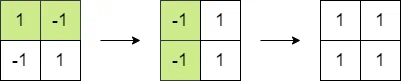
Input: matrix = [[1,-1],[-1,1]]
Output: 4
Explanation: We can follow the following steps to reach sum equals 4:
- Multiply the 2 elements in the first row by -1.
- Multiply the 2 elements in the first column by -1.
Example 2:
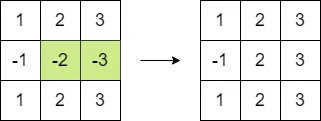
Input: matrix = [[1,2,3],[-1,-2,-3],[1,2,3]]
Output: 16
Explanation: We can follow the following step to reach sum equals 16:
- Multiply the 2 last elements in the second row by -1.
Constraints:
n == matrix.length == matrix[i].length2 <= n <= 250-105 <= matrix[i][j] <= 10^5
Solution
If the number of negative elements is even, we can always make it positive. If the number is odd, we can always choose the smallest absolute value to make it negative.
| |
| |
1161. Maximum Level Sum of a Binary Tree 2026.01.06
Given the root of a binary tree, the level of its root is 1, the level of its children is 2, and so on.
Return the smallest level x such that the sum of all the values of nodes at level x is maximal.
Example 1:
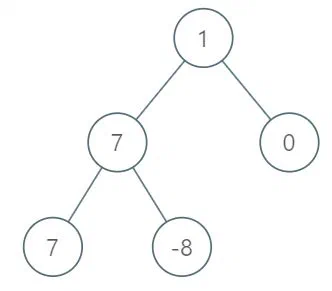
Input: root = [1,7,0,7,-8,null,null]
Output: 2
Explanation:
Level 1 sum = 1.
Level 2 sum = 7 + 0 = 7.
Level 3 sum = 7 + -8 = -1.
So we return the level with the maximum sum which is level 2.
Example 2:
Input: root = [989,null,10250,98693,-89388,null,null,null,-32127]
Output: 2
Constraints:
- The number of nodes in the tree is in the range
[1, 10^4]. -10^5 <= Node.val <= 10^5
Solution
Loop by hierarchy and compare
| |
| |
Avril
3761. Minimum Absolute Distance Between Mirror Pairs 2026.04.17
You are given an integer array nums.
A mirror pair is a pair of indices (i, j) such that:
0 <= i < j < nums.length, andreverse(nums[i]) == nums[j], wherereverse(x)denotes the integer formed by reversing the digits ofx. Leading zeros are omitted after reversing, for examplereverse(120) = 21.
Return the minimum absolute distance between the indices of any mirror pair. The absolute distance between indices i and j is abs(i - j).
If no mirror pair exists, return -1.
Example 1:
Input: nums = [12,21,45,33,54]
Output: 1
Explanation:
The mirror pairs are:
- (0, 1) since
reverse(nums[0]) = reverse(12) = 21 = nums[1], giving an absolute distanceabs(0 - 1) = 1. - (2, 4) since
reverse(nums[2]) = reverse(45) = 54 = nums[4], giving an absolute distanceabs(2 - 4) = 2.
The minimum absolute distance among all pairs is 1.
Example 2:
Input: nums = [120,21]
Output: 1
Explanation:
There is only one mirror pair (0, 1) since reverse(nums[0]) = reverse(120) = 21 = nums[1].
The minimum absolute distance is 1.
Example 3:
Input: nums = [21,120]
Output: -1
Explanation:
There are no mirror pairs in the array.
Constraints:
1 <= nums.length <= 1051 <= nums[i] <= 109
Solution
| |
1855. Maximum Distance Between a Pair of Values
You are given two non-increasing 0-indexed integer arrays nums1 and nums2.
A pair of indices (i, j), where 0 <= i < nums1.length and 0 <= j < nums2.length, is valid if both i <= j and nums1[i] <= nums2[j]. The distance of the pair is j - i.
Return the maximum distance of any valid pair (i, j). If there are no valid pairs, return 0.
An array arr is non-increasing if arr[i-1] >= arr[i] for every 1 <= i < arr.length.
Example 1:
Input: nums1 = [55,30,5,4,2], nums2 = [100,20,10,10,5] Output: 2 Explanation: The valid pairs are (0,0), (2,2), (2,3), (2,4), (3,3), (3,4), and (4,4). The maximum distance is 2 with pair (2,4).
Example 2:
Input: nums1 = [2,2,2], nums2 = [10,10,1]
Output: 1
Explanation: The valid pairs are (0,0), (0,1), and (1,1). The maximum distance is 1 with pair (0,1).
Example 3:
Input: nums1 = [30,29,19,5], nums2 = [25,25,25,25,25]
Output: 2
Explanation: The valid pairs are (2,2), (2,3), (2,4), (3,3), and (3,4). The maximum distance is 2 with pair (2,4).
Constraints:
1 <= nums1.length, nums2.length <= 1051 <= nums1[i], nums2[j] <= 105- Both
nums1andnums2are non-increasing.
Solutions
First try: $\mathcal{O}(mn)$ TLE
| |
Second try: $\mathcal{O}(m \log(n))$ optimzed with bisect method
| |
Third try: $\mathcal{O}(m+n)$with two pointers
| |
2615. Sum of Distances 2026.04.23
You are given a 0-indexed integer array nums. There exists an array arr of length nums.length, where arr[i] is the sum of |i - j| over all j such that nums[j] == nums[i] and j != i. If there is no such j, set arr[i] to be 0.
Return the array arr.
Example 1:
Input: nums = [1,3,1,1,2]
Output: [5,0,3,4,0]
Explanation:
When i = 0, nums[0] == nums[2] and nums[0] == nums[3]. Therefore, arr[0] = |0 - 2| + |0 - 3| = 5.
When i = 1, arr[1] = 0 because there is no other index with value 3.
When i = 2, nums[2] == nums[0] and nums[2] == nums[3]. Therefore, arr[2] = |2 - 0| + |2 - 3| = 3.
When i = 3, nums[3] == nums[0] and nums[3] == nums[2]. Therefore, arr[3] = |3 - 0| + |3 - 2| = 4.
When i = 4, arr[4] = 0 because there is no other index with value 2.
Example 2:
Input: nums = [0,5,3]
Output: [0,0,0]
Explanation: Since each element in nums is distinct, arr[i] = 0 for all i.
Constraints:
1 <= nums.length <= 1050 <= nums[i] <= 109
Solution
First step, group the index of equal elements. Second step, use prefix sum from left to right and from right to left, each time an index moves right, left prefix sum add (num of elements on the left) * (diff between current element and left element), right prefix sum add (num of elements on the right) * (diff between right element and current element)
| |
1391. Check if There is a Valid Path in a Grid 2026.04.27
You are given an m x n grid. Each cell of grid represents a street. The street of grid[i][j] can be:
1which means a street connecting the left cell and the right cell.2which means a street connecting the upper cell and the lower cell.3which means a street connecting the left cell and the lower cell.4which means a street connecting the right cell and the lower cell.5which means a street connecting the left cell and the upper cell.6which means a street connecting the right cell and the upper cell.
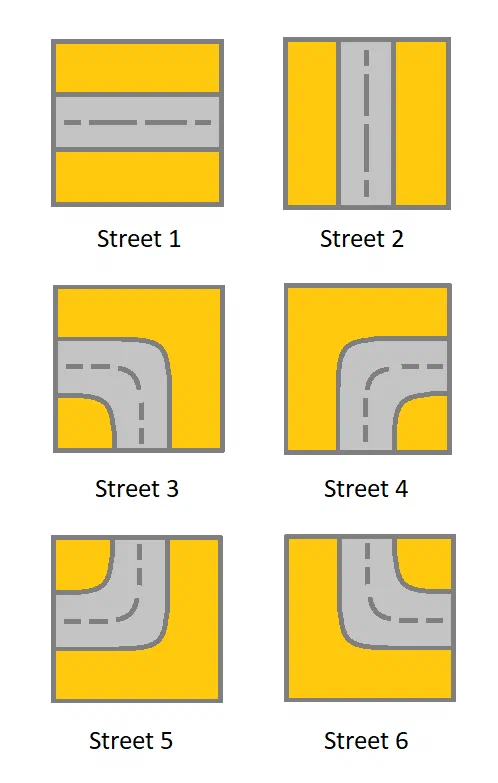
You will initially start at the street of the upper-left cell (0, 0). A valid path in the grid is a path that starts from the upper left cell (0, 0) and ends at the bottom-right cell (m - 1, n - 1). The path should only follow the streets.
Notice that you are not allowed to change any street.
Return true if there is a valid path in the grid or false otherwise.
Example 1:
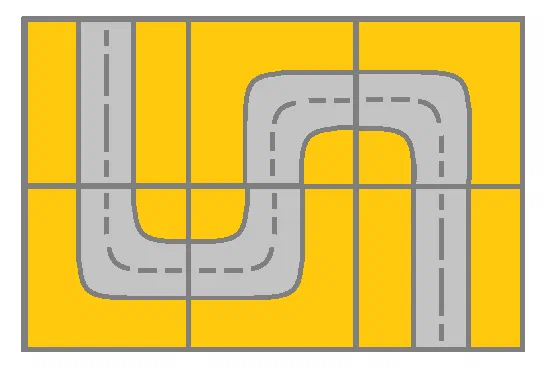
Input: grid = [[2,4,3],[6,5,2]]
Output: true
Explanation: As shown you can start at cell (0, 0) and visit all the cells of the grid to reach (m - 1, n - 1).
Example 2:
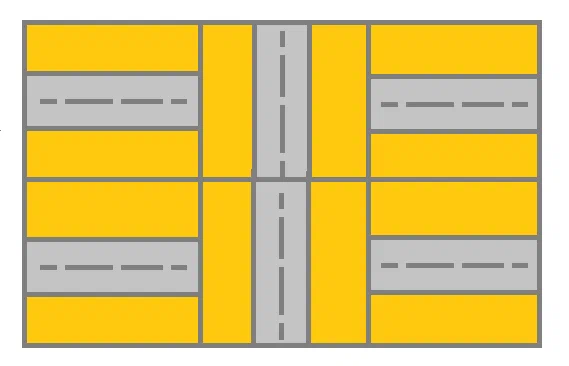
Input: grid = [[1,2,1],[1,2,1]]
Output: false
Explanation: As shown you the street at cell (0, 0) is not connected with any street of any other cell and you will get stuck at cell (0, 0)
Example 3:
Input: grid = [[1,1,2]]
Output: false
Explanation: You will get stuck at cell (0, 1) and you cannot reach cell (0, 2).
Constraints:
m == grid.lengthn == grid[i].length1 <= m, n <= 3001 <= grid[i][j] <= 6
Solution
Start from point [0, 0] with BFS. First check next available point, if it
- does not exceed the boundary
- has backward connectivity
- is not in current visited list (avoid loop) then append it to the queue.
| |
June
2161. Partition Array According to Given Pivot 2026.06.08
You are given a 0-indexed integer array nums and an integer pivot. Rearrange nums such that the following conditions are satisfied:
- Every element less than
pivotappears before every element greater thanpivot. - Every element equal to
pivotappears in between the elements less than and greater thanpivot. - The relative order of the elements less than
pivotand the elements greater thanpivotis maintained.- More formally, consider every
pi,pjwherepiis the new position of theithelement andpjis the new position of thejthelement. Ifi < jand both elements are smaller (or larger) thanpivot, thenpi < pj.
- More formally, consider every
Return nums after the rearrangement.
Example 1:
Input: nums = [9,12,5,10,14,3,10], pivot = 10
Output: [9,5,3,10,10,12,14]
Explanation:
The elements 9, 5, and 3 are less than the pivot so they are on the left side of the array.
The elements 12 and 14 are greater than the pivot so they are on the right side of the array.
The relative ordering of the elements less than and greater than pivot is also maintained. [9, 5, 3] and [12, 14] are the respective orderings.
Example 2:
Input: nums = [-3,4,3,2], pivot = 2
Output: [-3,2,4,3]
Explanation:
The element -3 is less than the pivot so it is on the left side of the array.
The elements 4 and 3 are greater than the pivot so they are on the right side of the array.
The relative ordering of the elements less than and greater than pivot is also maintained. [-3] and [4, 3] are the respective orderings.
Constraints:
1 <= nums.length <= 10^5-10^6 <= nums[i] <= 10^6pivotequals to an element ofnums.
Solution
| |
| |
Notes: concatenate vector in c++
| |
concatenate vector in rust
- append
| |
append takes a mutable reference, and will move elements from vec2 to vec1. vec2 will be empty after the operation.
- extend
| |
vec2 will remain unchanged
- concat
| |
This will create a new element and keep vec1 and vec2
3689. Maximum Total Subarray Value I 2026.06.09
You are given an integer array nums of length n and an integer k.
You need to choose exactly k non-empty nums[l..r] of nums. Subarrays may overlap, and the exact same subarray (same l and r) can be chosen more than once.
The value of a subarray nums[l..r] is defined as: max(nums[l..r]) - min(nums[l..r]).
The total value is the sum of the values of all chosen subarrays.
Return the maximum possible total value you can achieve.
Example 1:
Input: nums = [1,3,2], k = 2
Output: 4
Explanation:
One optimal approach is:
- Choose
nums[0..1] = [1, 3]. The maximum is 3 and the minimum is 1, giving a value of3 - 1 = 2. - Choose
nums[0..2] = [1, 3, 2]. The maximum is still 3 and the minimum is still 1, so the value is also3 - 1 = 2.
Adding these gives 2 + 2 = 4.
Example 2:
Input: nums = [4,2,5,1], k = 3
Output: 12
Explanation:
One optimal approach is:
- Choose
nums[0..3] = [4, 2, 5, 1]. The maximum is 5 and the minimum is 1, giving a value of5 - 1 = 4. - Choose
nums[0..3] = [4, 2, 5, 1]. The maximum is 5 and the minimum is 1, so the value is also4. - Choose
nums[2..3] = [5, 1]. The maximum is 5 and the minimum is 1, so the value is again4.
Adding these gives 4 + 4 + 4 = 12.
Constraints:
1 <= n == nums.length <= 5 * 10^40 <= nums[i] <= 10^91 <= k <= 10^5
Solutions
| |
2130. Maximum Twin Sum of a Linked List 2026.06.14
In a linked list of size n, where n is even, the ith node (0-indexed) of the linked list is known as the twin of the (n-1-i)th node, if 0 <= i <= (n / 2) - 1.
- For example, if
n = 4, then node0is the twin of node3, and node1is the twin of node2. These are the only nodes with twins forn = 4.
The twin sum is defined as the sum of a node and its twin.
Given the head of a linked list with even length, return the maximum twin sum of the linked list.
Example 1:

Input: head = [5,4,2,1]
Output: 6
Explanation:
Nodes 0 and 1 are the twins of nodes 3 and 2, respectively. All have twin sum = 6.
There are no other nodes with twins in the linked list.
Thus, the maximum twin sum of the linked list is 6.
Example 2:

Input: head = [4,2,2,3]
Output: 7
Explanation:
The nodes with twins present in this linked list are:
- Node 0 is the twin of node 3 having a twin sum of 4 + 3 = 7.
- Node 1 is the twin of node 2 having a twin sum of 2 + 2 = 4.
Thus, the maximum twin sum of the linked list is max(7, 4) = 7.
Example 3:

Input: head = [1,100000]
Output: 100001
Explanation:
There is only one node with a twin in the linked list having twin sum of 1 + 100000 = 100001.
Constraints:
- The number of nodes in the list is an even integer in the range
[2, 105]. 1 <= Node.val <= 105
Solutions
| |
2095. Delete the Middle Node of a Linked List 2026.06.15
You are given the head of a linked list. Delete the middle node, and return the head of the modified linked list.
The middle node of a linked list of size n is the ⌊n / 2⌋th node from the start using 0-based indexing, where ⌊x⌋ denotes the largest integer less than or equal to x.
- For
n=1,2,3,4, and5, the middle nodes are0,1,1,2, and2, respectively.
Example 1:

Input: head = [1,3,4,7,1,2,6]
Output: [1,3,4,1,2,6]
Explanation:
The above figure represents the given linked list. The indices of the nodes are written below.
Since n = 7, node 3 with value 7 is the middle node, which is marked in red.
We return the new list after removing this node.
Example 2:

Input: head = [1,2,3,4]
Output: [1,2,4]
Explanation:
The above figure represents the given linked list.
For n = 4, node 2 with value 3 is the middle node, which is marked in red.
Example 3:

Input: head = [2,1]
Output: [2]
Explanation:
The above figure represents the given linked list.
For n = 2, node 1 with value 1 is the middle node, which is marked in red.
Node 0 with value 2 is the only node remaining after removing node 1.
Constraints:
- The number of nodes in the list is in the range
[1, 105]. 1 <= Node.val <= 105
Solution
- get the length of list first, then delete the middle one
| |
- Two pointers
| |